Why Christmas makes food feel so complicated (and how to be kinder to yourself about it)
The uncomfortable feelings around food at Christmas time always started earlier than I expected. The exciting new snack aisle in M&S in September. A tin of something festive on someone's desk in November. And a niggling voice that said: if you don't try that now, you'll miss out.
And then the media joins in. Influencers are doing taste tests of everything seasonal, and something random goes viral for no particular reason (remember Heston's Christmas pudding in 2010?? Suddenly your entire Christmas could only be a 7/10 if you didn't have a pudding with a caramelised orange inside it!)
Here's the thing though - that pull is real, and it isn't silly. Seasonal food genuinely disappears on 27th December, and wanting to try it is a very human thing to want. If you've found yourself eating your way through a stressful December evening, or buying the novelty thing you didn't even fancy that much, nothing is wrong with you. This post is about why it happens, and how to meet it with a bit more kindness.
Why Christmas feels like so much
Food is only one layer of the nightmare before Christmas. Look at what else is quietly stacking up...
There's the money you don't really have, spent on gifts for people who are already getting a million others. There's the pressure to give your child the best Christmas they've ever seen, and to make the house look amazing, but not so amazing that people think you're showing off, and not so understated that you look like the Grinch. There's the dinner logistics: shopping early enough to dodge the Christmas Eve crowds, but not so early that your vegetables are feeling sorry for themselves on Christmas Day. There are the parties and get-togethers, and the quiet pressure to look your best for them. There are the cold, dark evenings, the tiredness, and the broken routines.
And sitting on top of all of it, the quietest pressure of the lot: don't gain any weight, so you don't have to spend January punishing yourself to undo the damage.
Each of these is a small stress. But together it's a lot. When you're carrying that much, with very little headspace left, food becomes the one thing on the list that is quick, available, and reliably comforting. Reaching for it when you're stressed, what's often called emotional or "comfort" eating, isn't a lack of willpower. It's a very human way of coping, wrapped up in sparkly, festive packaging.
Psychotherapist Julia Buckroyd, author of Understanding Your Eating, points out that, as far as we know, every human society has used food for emotional purposes, and has done for thousands of years. We mark weddings, funerals, births and coming of age with it, and with food so plentiful now, hardly any gathering or milestone happens without it. As she puts it, "the emotional use of food is normal", and nearly all of us do it to some extent. So, just to be clear, this is not a "you" problem.
In practice it looks like this. It's 9pm. Presents are wrapped, one more "last" online order is placed, and the tin of Quality Street you bought for Christmas Day is open on the sofa beside you. The battle with yourself not to open it was too much, so you just turned off the voices and opened it. And now it needs replacing before you have to admit to anyone what you've just done.

For me, the first stress of the season was the work Christmas party. I went from not giving two hoots what anyone thought of my appearance between 9 and 5:30 to buying ten outfits from ASOS and fad-dieting the crap out of November so that I'd be the belle of the SaaS Christmas ball. One year, none of the ten outfits were right, nothing I owned fitted me, and I was so close to not going. I squeezed into a pair of black jeans and a loose black top at the last minute and hoped no one would look at me. Turns out it was quite fun, actually, and my outfit had absolutely nothing to do with it. The pressure was wild, and none of it came from anyone else in that room. Who knew?!
Why fighting the pull makes it louder
Most of us respond to all this by trying to stamp something out, either the feeling, or the food.
"I'll be good until Christmas Day."
"I'll sort it out in January."
"I'll just try this one and then I won't have anymore."
It sounds disciplined, but it's the same all-or-nothing trapdoor as ever, just with tinsel on. Planning to make up for Christmas in January is diet culture talking. It makes a month of normal eating feel like a mistake you'll have to fix.
There's an idea in Acceptance and Commitment Therapy, or ACT, that explains why this backfires. ACT suggests that much of our distress comes not from the difficult feeling itself, but from the struggle to get rid of it. Trying hard not to feel stressed, not to want the mince pie, not to eat the mince pie, takes a lot of energy, and it tends to make the pull louder. (I've chosen mince pies because they are my seasonal weapon of choice...I know they're not for everyone, so amend as applicable!)
Then comes the second layer: the criticism.
"Why did I just do that to myself?!"
"Why can't I just have some self-control?"
"What is wrong with me?"
In the same book, Julia Buckroyd notes how harshly people talk about themselves around food, calling themselves greedy or berating themselves for having no willpower - as if willpower works for everyone else but not for them. Now you've got both the original stress and a pile of shame on top, and shame rarely helps anyone feel more settled around food.
A kinder way through
ACT offers a different route. Instead of fighting what you feel, you make room for it, then choose what to do based on what matters to you rather than what the pressure is shouting. In real life, that can look like this:
Make room for the pull. Notice it, name it, and let it be there. There's the urge to try the novelty snack. There's the stress about looking good at the party. You don't have to obey a feeling, and you don't have to wrestle it either. Wanting the mince pie isn't a problem to be solved.
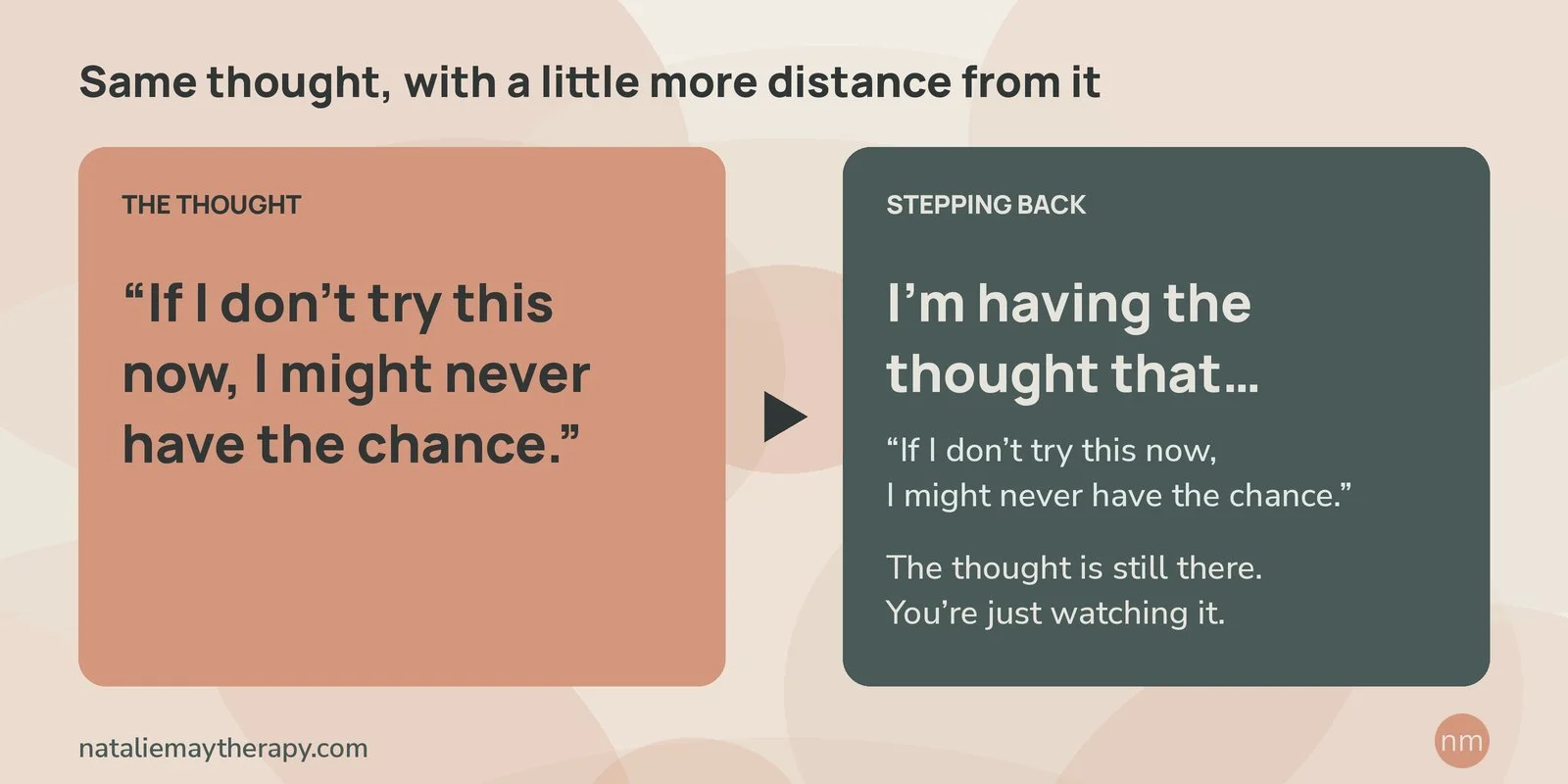
Notice the thought rather than taking orders from it. "I've blown it, I may as well carry on" is a thought, not a fact. ACT calls distancing yourself from this cognitive defusion, and one simple way in is to add a phrase: "I'm having the thought that I've blown it." It sounds small, but it creates just enough space from the thought to let you make a choice about what comes next.
Ask what you'd like this Christmas to feel like. ACT calls this your values: what truly matters to you underneath the to-do list. Connection? Ease? Fun? Then let one small choice be guided by that instead of by the pressure. That might be saying no thanks to one of the parties, buying the ready-made gravy, or sitting down to properly enjoy the food you've been curious about, with nothing to make up for later.
Have the damn snack. If you want to try the limited-edition thing, try it. Sit down, taste it, enjoy it, and move on. And if you eat to take the edge off a stressful evening, that's allowed too. It's information about how much you're carrying, not a verdict on you. Be curious, not cruel.
And when a feeling seems too big to bear, see if you can ride it out just for 90 seconds before you do anything. The physical wave is shorter than you think. (I wrote about why in what "sitting with your feelings" actually means.)
When it feels like more than a seasonal wobble
For some people this isn't just December. It's a pattern that tightens every year, and no amount of knowing better makes it stop. Cognitive defusion and acceptance work are part of the toolkit I use with clients, alongside hypnosis, to build a calmer response to the pull of food and a kinder way of talking to yourself about it.
If this sounds familiar and you'd like to talk it through before the season really kicks in, why not book a free discovery call through the link below?
References
Buckroyd, J. (2011) Understanding Your Eating: How to Eat and Not Worry About It. Open University Press, p. 16.
Hayes, S. C., Strosahl, K. D. and Wilson, K. G. (2012) Acceptance and Commitment Therapy: The Process and Practice of Mindful Change, 2nd edn. New York: Guilford Press.