What "sitting with your feelings" actually means (and why it's not as hard as you thought)
For years, people in the wellness space would tell me that in order to stop emotional eating, I had to "sit with my feelings." I nodded along like I understood, but honestly, I didn't. To me, sitting with a feeling sounded like being trapped in a room with a snake for hours with no way out. So the moment discomfort showed up, I did what I knew would stop it in its tracks, and I ate.
It turned out I had massively misjudged the whole thing. And finally understanding what "sitting with your feelings" meant really helped me turn a corner.
Why sitting with your feelings feels so hard
Many of us assume accepting difficult emotions is like an endurance event. Anxiety, sadness, anger, shame…we picture them as long, heavy states that settle in and refuse to leave. If that's what you believe, just as I did, doing what you need to do to avoid them makes complete sense. Who would choose to sit with something uncomfortable? And yet we're told constantly that discomfort is a personal failing to fix, rather than something every human body is wired to do. If our brain senses something as a threat, physical or otherwise, it tells us to run away from it. And the more we run away, the more we're confirming to our brains that it was, in fact, a real threat. That's why anxiety can feel so challenging to budge - because facing it feels like too much to bear.
But that's not actually how emotions work at a physiological level…
What the research says
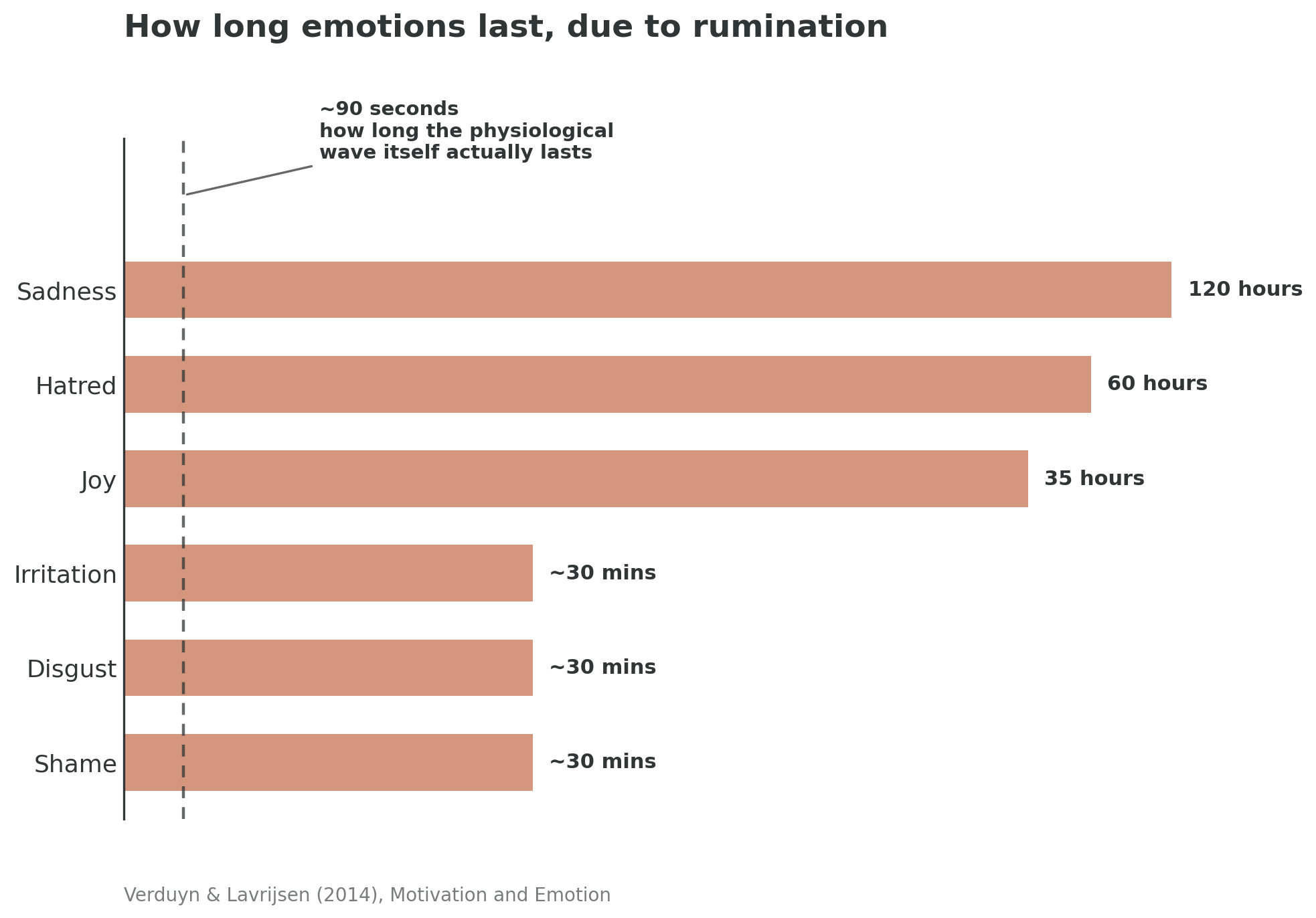
Neuroanatomist Dr Jill Bolte Taylor found that the initial physiological surge of an emotion - the racing heart, the tight chest, the flush of chemicals your body releases, runs its course in around 90 seconds if left alone. After that, anything that keeps the feeling going isn't the original chemical reaction anymore, it's simply your mind keeping it going by thinking about it.
This is where it gets more interesting (and more useful!). Psychologist Philippe Verduyn has spent years researching emotion duration specifically, and his findings show something more nuanced than a single fixed number. In one study of 233 students, he found huge variation between emotions. Disgust and shame, for example, passed within around 30 minutes on average. Sadness, on the other hand, lasted around 120 hours on average.
The difference wasn't the emotion itself, however. It was how much people ruminated, how much someone replayed, analysed, and retold the story of what happened. The more the mind kept returning to it, the longer the emotion stuck.
Put simply: the body moves through a feeling fast. It's the thinking that drags it out.
What this means in reality
Once I understood this, the "sit with your feelings" advice actually started to make sense. It was never about grimly enduring something for hours. It was about staying present through the initial wave, which is incredibly short, rather than reacting to make it disappear, which is what kept me stuck in a much longer cycle of guilt, restriction, and bingeing.
A perfect example is when I had reintroduced one of my most regular rules, that I wasn't going to eat sugar EVER AGAIN. Of course I see now that I was setting myself up to fail. Diet culture loves an all-or-nothing rule like that. It sounds strong and disciplined, but it was actually just a trapdoor. So when tomorrow came and I was faced with cake in the office, it spoke to me all day until I finally gave in. I was so disgusted with myself that I beat myself up all the way home. That berating voice led me to the shop where I bought some chocolate to stop the noise for a moment. Of course, once I'd eaten that, I was beside myself…what was wrong with me?! And round and round it went. Eat to avoid the feelings, create more feelings by eating. Rinse, repeat. Somewhere, the day before, something had created a feeling that I really only needed to endure for 90 seconds, but somehow I created a painful spiral that lasted for days.
For years, eating had become my way of managing that initial spike of discomfort. Not because I lacked willpower, but because I'd built a genuine association between difficult feelings and food - an automatic response that would fire before I'd even registered what was happening.
How therapy helps with emotional eating
Breaking that association isn't something that happens by simply knowing the research, although understanding what's actually going on in our bodies really does help. When my clients find themselves reaching for food, or using punishing levels of exercise to avoid difficult feelings, I help them build a toolkit that includes the following techniques:
Thought stopping, which interrupts the automatic pattern before it gathers momentum, giving you a moment to make a choice instead of being sucked into a helpless spiral.
Cognitive defusion, learning to notice a thought or feeling without getting tangled up in it or treating it as fact. A feeling can be present without dictating what happens next. This takes practice, but once you've mastered it, it will transform every part of your life, not just angst around food.
Acceptance work, learning to accept discomfort in the moment, rather than feeling the need to fight it.

I complement some of these approaches with hypnosis, making what you learn easier to absorb and put into practice.
None of this is about forcing yourself to be stoic or pretending discomfort doesn't exist. It's about recognising that the wave can be over in less than two minutes, and building the tools to ride it out rather than reaching for a coping strategy that only makes it worse in the long run.
The takeaway (no pun intended)
If you avoid “sitting with your feelings” because you believe they will last for hours, it's worth knowing that the body's part in that process is genuinely brief and that what keeps it going is the story we build around it, not the feeling itself.
Unpicking an automatic response that's been reinforced for years takes some structured work, but it's far easier to master than many people assume.
If this resonates and you'd like to talk through how this kind of work applies to your own relationship with food, why not book a free discovery call through the link below to start the conversation.