Does hypnotherapy work for emotional eating?
Short answer: yes, it can, but perhaps not in the way you're picturing.
If you've landed here, I guess you've already tried the obvious things 100 times. Cutting out biscuits. Not keeping them in the house. Promising yourself you'll only eat when you're actually hungry. But I'd also guess those things worked for a bit (some for a few months, others just hours, right?), then didn't, and now you know it’s not really about the food, and you're looking for something that reaches deeper.
So let's talk about what hypnotherapy actually does for emotional eating, what it doesn't, and what the research says.
First, what emotional eating actually is
Emotional eating is eating in response to a feeling rather than to hunger. Stress, boredom, loneliness, anxiety… The food becomes a way of managing the feeling, and often a very effective one in the short term, which is precisely why it's so hard to stop.
Here's the bit that gets missed. Emotional eating isn't a willpower problem. It's a learned response. Somewhere along the line, your brain worked out that food reliably changes how you feel, and it filed that away as a useful strategy. Every time you use it, that pathway gets a little stronger. That's not weakness. That's just how learning works.
Which is also the reason why "just don't do it" doesn't work. You're trying to argue with a habit that runs faster than your reasoning does.
Where hypnotherapy fits in
This is where I need to clear something up. Hypnotherapy is not someone putting you in a trance and telling you that you no longer like chocolate. If only it were that simple!
What I practise is Cognitive Behavioural Hypnotherapy, which combines two things:
The CBT part helps you recognise and understand the pattern. What triggers the urge, what you're telling yourself in that moment, what the food is doing for you emotionally, and what you'd need instead. This is the conscious, thinking work. Honestly, building up that awareness and actively pushing against it can sometimes be tiring, but it’s the only way that long-term change can take place. We have decades of unlearning to do. But don’t worry, that’s where hypnotherapy comes in…
The hypnotherapy part works on the automatic responses that run underneath everything we do. That's the bit of you that heads to the cupboard before you've even consciously decided anything. In a focused, relaxed state, your mind becomes more open to rehearsing a different response and letting the old one loosen its grip.
You're aware the whole time. Nothing happens without you. It's not a shortcut around the work, it's just a way of boosting your motivation, helping the work stick, and making it feel much easier along the way.
What the research on hypnotherapy for emotional eating actually says
Research into hypnosis for eating behaviour has produced mixed results, partly because the studies vary a lot in quality and in what they actually measure. Reviews tend to describe hypnosis as promising rather than proven, particularly for cravings, food awareness and emotional eating.
Where the evidence is stronger is in combination. Several analyses have found that adding hypnosis to cognitive behavioural approaches tends to produce better and longer-lasting results than CBT on its own. That's the combination I use, and it's the reason I trained in it rather than in either approach alone.
So the fair summary is: hypnotherapy by itself, as a standalone fix, has patchy evidence. Hypnotherapy used alongside CBT to change the thinking and the automatic habits together is where it earns its place.
What Cognitive Behavioural Hypnotherapy can realistically do
Working this way, people I work with typically notice a few things shift, often sooner than they expect:
The gap between feeling something and reaching for food gets wider. There's a pause and a moment of recognition where there wasn't one before. In short, it gives you time to notice and make a choice.
They start to recognise what they're actually feeling, rather than just noticing the drive to eat. (Don’t underestimate how empowering this is!)
The food loses some of its emotional weight. It stops being the enemy or the reward and starts just being food.
The self-criticism after eating quietens down, which matters more than you’d imagine because the shame is usually what drives the next round.
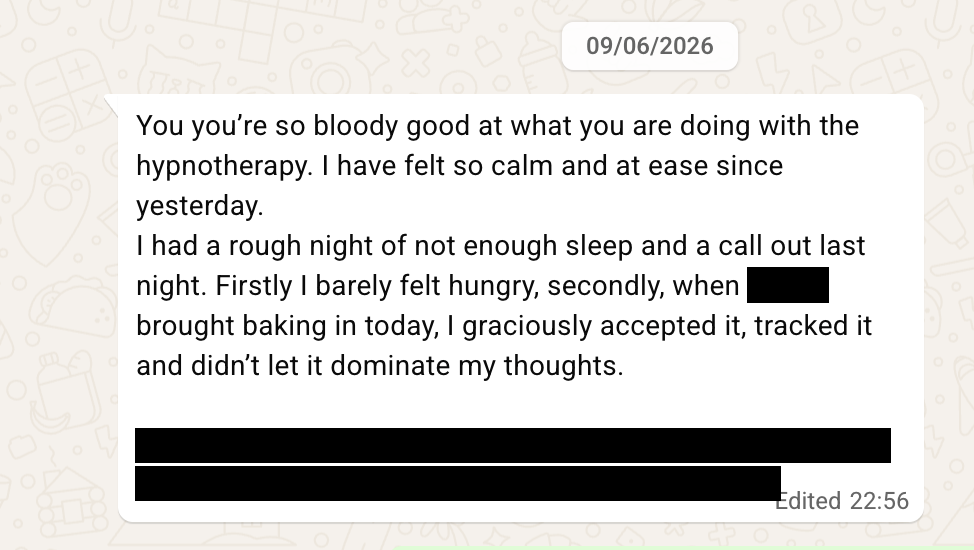
This is a message from someone I worked with, sent just two sessions in. Shared with her permission.
What hypnotherapy can't do for emotional eating
It can't stop you ever eating for comfort again. Humans eat for comfort. That's fine and normal, and any approach that promises to remove it entirely is, in my opinion, not being fully open with you.
It won't work if you just want it “done to you”. Hypnotherapy is a collaborative process that requires effort from both sides, so closing your eyes and hoping a therapist will magic away your desire to eat chocolate won’t work. Not in the long-term, at least. The patterns that we’ve built up over time can absolutely be changed, but not in an hour. I get it! I looked for these fixes myself. But eventually I developed this way of working for the people who are genuinely tired of the ups and downs of chronic dieting - exhausted by constantly feeling like they’ve let themselves down, and just want to start living without that negative voice telling them they don’t get to live until they’re thin.
And it isn't a weight-loss programme. Some people's bodies change when they stop turning to food as an emotional response, some don't. But that's not the goal. The goal is to take food off your mind and stop it being a source of stress in your life. My weight continues to fluctuate since I made peace with food and my body. Christmas and holidays always result in weight gain for me. The difference now is I no longer see that as failure. You only get one chance at this life - how much more of it do you want to spend worrying about whether you should have eaten that cake or not?

Is it right for you?
The people who take the most from our work together are those who are done with diets, tired of the cycle, and ready to change what's actually going on rather than just manage the symptoms.
The easiest way to find out whether Cognitive Behavioural Hypnotherapy will help you find peace and freedom around food is with a free 20-minute conversation. No commitment, no pressure. You tell me a bit about what's going on, ask whatever you need, and we work out together whether this approach feels right.
Or if you'd like to know more about how sessions actually work first - either online or in person in my therapy space in Hove, you can find out what to expect here.