The single biggest myth diet culture is trying to sell you
Willpower. The diet industry has made billions from the idea that willpower is the answer to a healthy lifestyle. But if it were, we'd all have figured it out by now (and diet culture wouldn’t be a thing!)
We’ve all tried it. Repeatedly, with genuine commitment and real effort, as if we just didn’t quite get it right the first 158 times. And yet here you are. Not because you're weak, or lazy, or lack discipline. But because willpower was never the right tool for the job.
First, let's clear a few things up
Disordered eating is one of those topics that comes loaded with assumptions - most of them wrong.
It only affects women. It's about vanity. It's a phase. It's what happens when someone "lets themselves go." It's not a real problem, not like proper mental health issues.
All of it, wrong.
Let's talk gender, because it matters. Around 40% of people with binge eating disorder are male, but you wouldn't know it from the way it is talked about. Men who struggle with food are more likely to have it reframed as a fitness goal, a discipline issue, or just "having a big appetite”. People of all genders struggle with their relationship with food, whether we talk about it or not.
The desire to control food is often about needing to feel in control of something when everything else feels chaotic, and that cuts across body types, income brackets, personality types. It explains why it shows up in high-functioning, apparently sorted people just as much as anyone else.
"Have you tried drinking a glass of water?"
Ah yes. The advice.
If you've spent any time looking for help with your relationship with food, you'll have encountered it. "Need something sweet? Try eating some fruit." "Cravings are often just thirst - have a glass of water and wait twenty minutes." "Have you tried keeping a food diary?"
To be fair to the apple, it means well. It just fundamentally misses the point.
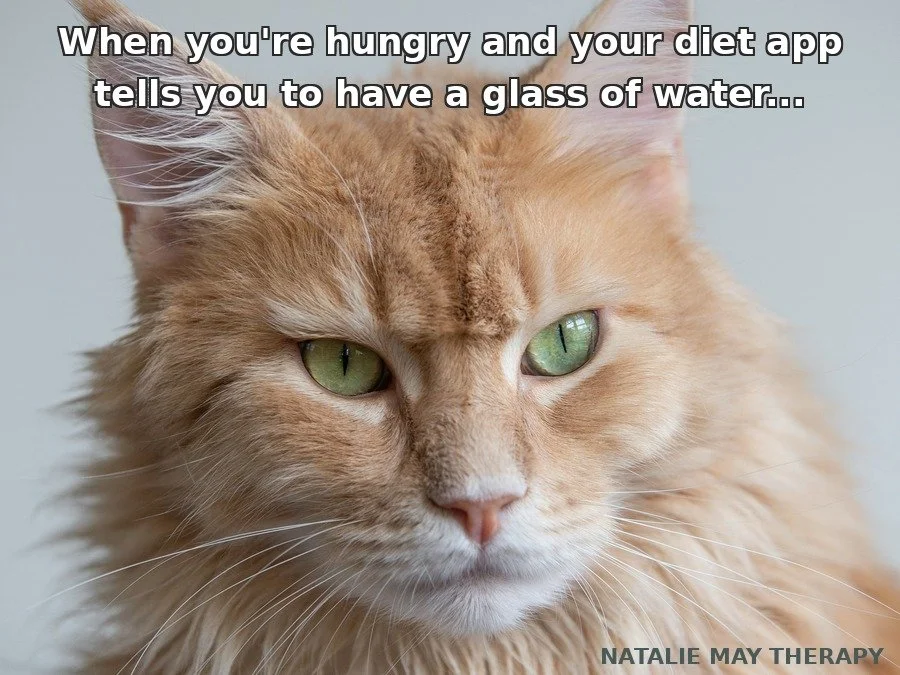
Disordered eating patterns aren't a problem of logic. They're not caused by forgetting that fruit exists, or by mild dehydration. They're deeply ingrained responses, often developed over years, sometimes decades, that operate well below the level of conscious decision-making. Telling someone to drink more water is a bit like telling someone with a fear of flying to just remember that planes are statistically very safe. Technically true. Profoundly unhelpful.
The same goes for most traditional diet advice. Calorie counting, cutting out food groups, following a plan, these things can create short-term behaviour change. What they can't do is touch the underlying patterns that drove the behaviour in the first place. Which is why, for so many people, the results don't last. But there’s always one glamorous brand ambassador who nailed it, isn’t there, telling us “we’ve got this” and making us feel like we were the only ones who couldn’t make it work.
So what's actually going on?
In CBH, we often start with the Hot Cross Bun model (aptly named!) It’s a CBT framework that maps how thoughts, emotions, physical sensations and behaviours all connect and reinforce each other.
Here's a familiar example. You have a stressful day and feel completely overwhelmed (situation). Your stomach tightens, your jaw clenches, your shoulders creep up around your ears (sensations). You think "a bit of chocolate won't make a difference" (thought). You eat it, quickly, before it even registers (behaviour). Then comes the guilt, the shame, the annoyance with yourself (emotions). And the thought that follows: "I'll eat less tomorrow to make up for it." And round it goes.
None of this is a character flaw. It's a learned cycle, and like all learned cycles, it can be unlearned. But not by drinking a glass of water.
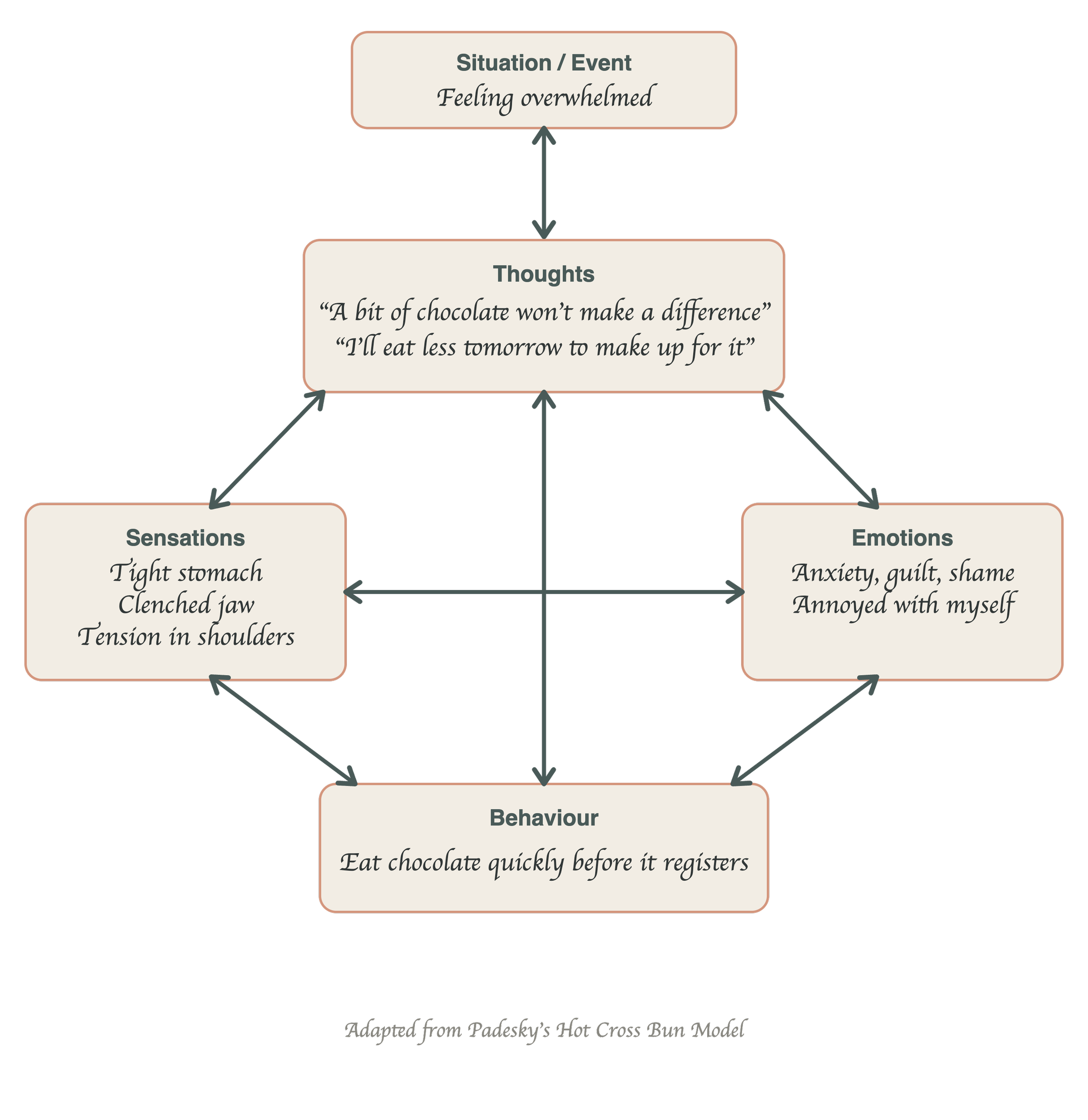
Awareness is the first step. Download this template from my resources page and fill it in with your own thoughts, emotions, behaviours, and sensations. You might be surprised by what you notice.
Why overcoming disordered eating takes work
Here's the part that no one particularly wants to hear, but that I think is important to say honestly: changing these patterns takes time and structure. Not punishment, not white-knuckling your way through a meal plan, but real, consistent work on the thoughts and responses that have been building and reinforcing themselves for years, sometimes since childhood. If you’re anything like I was…and if you’ve read this far, I’m guessing you might be…you’re over the quick fixes and ready to put in the effort to change this for good.
Thankfully, this is where hypnotherapy comes in to do some of the heavy lifting. While CBT helps us identify and challenge the thought patterns consciously, hypnotherapy works directly with the automatic responses that sit below conscious thought, the ones that fire before you've even registered what's happening. Together, they address the pattern at both levels, which is why CBH produces more lasting change than willpower alone ever could. Research found that hypnosis combined with other therapeutic interventions produced significantly better outcomes than either approach used alone.
It's not a quick fix. Anyone who tells you otherwise isn't telling you the whole story. But it is a long-lasting one. You won't look back in six months wondering how you ended up back at square one, feeling even worse than when you started.
When will I start to see a difference?
Change in this area rarely announces itself dramatically. It tends to be quieter than that. A realisation that you had the urge without acting on it. A snack that isn’t followed with guilt. A day where food just wasn't that loud.
That's not failure to achieve something bigger. That's the pattern loosening its grip. And that's exactly where the work starts to show. The good news is that this starts to happen very quickly.
“I have felt so calm and at ease since yesterday. I had a rough night with not enough sleep, and a call out last night. Firstly, I barely felt hungry, and secondly, when someone brought cake into the office today, I graciously accepted it, ate it, and didn’t let it dominate my thoughts. I can’t wait to see what I can achieve next!”
-Gemma M
If any of this sounds familiar
You don't need to be in crisis to get support. If your relationship with food takes up more headspace than you'd like, that's enough.
If you'd like to talk about whether CBH could help you stop the constant food noise, I'd love to hear from you.